
Description
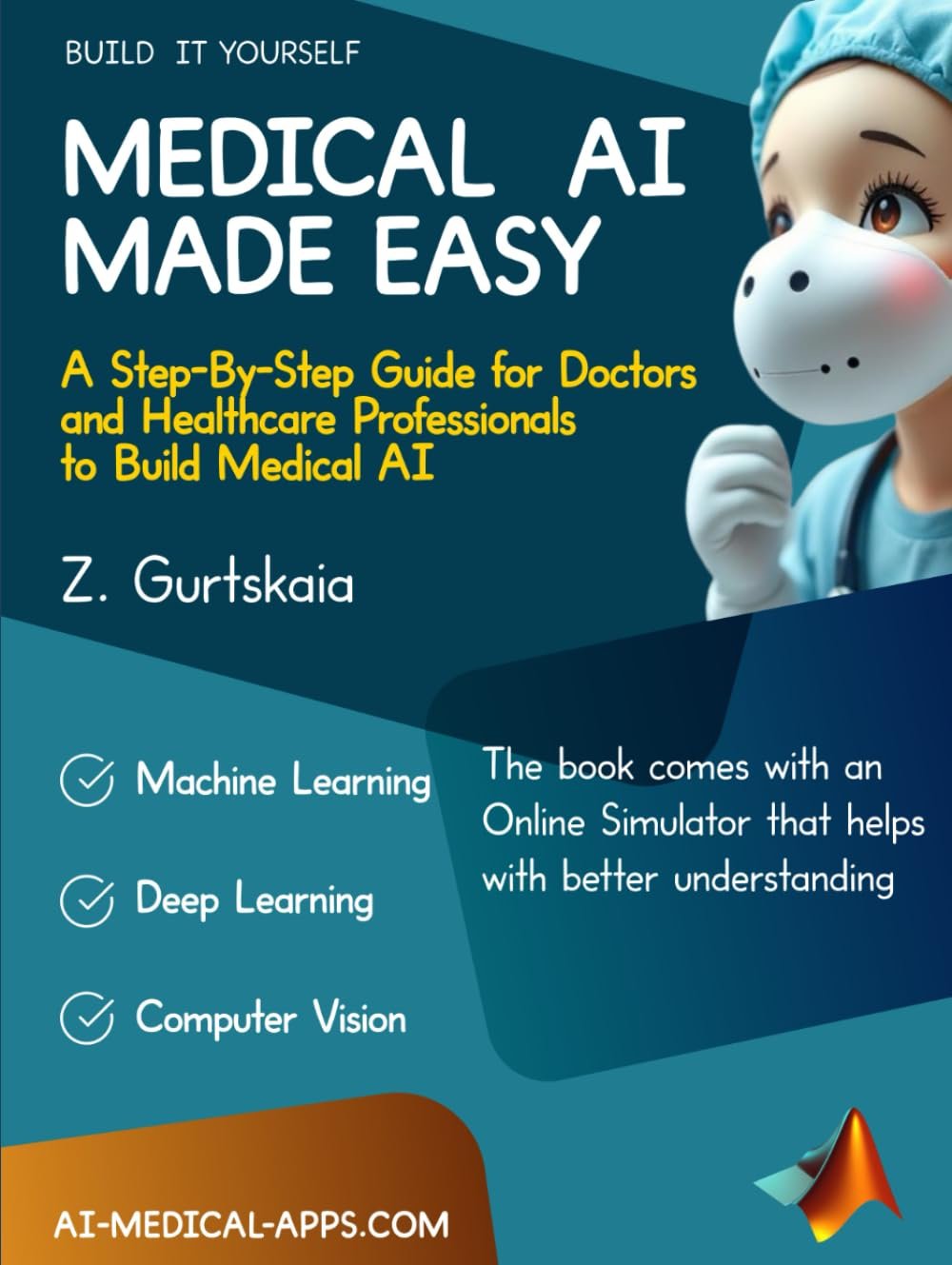
MEDICAL AI MADE EASY — Book Description
Medical AI Made Easy is a practical and accessible introduction to the rapidly growing field of artificial intelligence in healthcare and medicine. Designed to make complex technological concepts easier to understand, this book explores how artificial intelligence, machine learning, deep learning, natural language processing, and data-driven technologies are transforming the way healthcare is delivered, studied, and managed.
Artificial intelligence is no longer limited to computer science laboratories. It is increasingly becoming part of modern healthcare, where large amounts of medical data are generated every day through electronic health records, medical imaging, laboratory tests, wearable devices, research databases, and clinical documentation. Understanding how AI can work with this information is becoming increasingly valuable for healthcare professionals, students, researchers, technology enthusiasts, and anyone interested in the future of medicine.
Medical AI Made Easy begins with the fundamentals. Readers are introduced to the meaning of artificial intelligence and the basic ideas behind machine learning. Instead of assuming advanced programming or mathematical knowledge, the book focuses on explaining important concepts in a clear and approachable way. It helps readers understand how computers can identify patterns, learn from data, generate predictions, and assist with complex healthcare-related tasks.
One of the central topics is machine learning in healthcare. Machine-learning systems can be trained using medical datasets to recognize patterns and make predictions. The book introduces concepts such as training data, features, labels, classification, regression, prediction, model evaluation, and validation. Readers can develop a basic understanding of how these systems are designed and why careful testing is necessary before an AI model can be considered useful in a medical setting.
The book also introduces deep learning and neural networks, which have contributed to major advances in medical artificial intelligence. Deep-learning technologies can process complex datasets and are particularly useful when dealing with images, audio, text, and other high-dimensional information. The book explains the general principles behind neural networks and shows how these methods can contribute to healthcare applications without overwhelming readers with unnecessary technical complexity.
A significant part of medical AI involves medical imaging. Doctors and specialists work with a wide range of images, including X-rays, CT scans, MRI scans, ultrasound images, and pathology slides. AI-based image-analysis systems can assist with detecting patterns, classifying images, identifying areas that may require closer examination, and supporting diagnostic workflows. The book explores these applications while emphasizing that AI tools should support qualified healthcare professionals rather than replace clinical judgment.
Clinical decision support is another important area discussed throughout the book. Healthcare professionals frequently need to consider multiple sources of information when evaluating a patient. AI can help organize large datasets, identify relevant patterns, estimate risks, and provide decision-support information. Readers learn how AI can become part of clinical workflows and why medical professionals must understand the strengths, limitations, and uncertainty associated with algorithmic recommendations.
The book also introduces Natural Language Processing (NLP) and its role in healthcare. Medical information is often stored as written text, including clinical notes, discharge summaries, medical reports, research publications, and electronic health records. NLP allows computer systems to process and analyze human language. Potential applications include extracting useful information from clinical documents, organizing medical knowledge, assisting documentation, analyzing research literature, and supporting communication technologies.
Another important topic is generative AI in medicine. Modern AI systems can generate text, summarize information, assist with documentation, answer questions, and support certain research and administrative tasks. The book explains the possibilities of generative AI while also discussing the importance of verification, accuracy, privacy, and responsible use. Readers are encouraged to understand that AI-generated information should not automatically be treated as medically accurate or professionally validated.
Medical data forms the foundation of most AI applications. The quality of an AI system depends heavily on the quality, relevance, and representativeness of the data used to develop and evaluate it. The book explains why data collection, cleaning, organization, privacy, security, and validation are essential. It also introduces readers to important concerns such as missing data, biased datasets, inconsistent records, and differences between populations.
The book provides an accessible discussion of AI-assisted diagnosis and prediction. Artificial intelligence may help identify patterns associated with certain diseases, estimate patient risks, prioritize cases, or support early detection. However, medical predictions are complex, and AI systems can make mistakes. Therefore, the book emphasizes the importance of clinical validation, appropriate testing, human oversight, and continuous monitoring.
Personalized and precision medicine is another emerging application of AI. Patients may respond differently to the same treatment because of differences in genetics, medical history, lifestyle, environment, and other factors. AI can analyze complex datasets to help researchers understand these differences and potentially support more individualized approaches to healthcare. The book explains the basic concept of personalized medicine and how data-driven technologies may contribute to its development.
The book also explores AI applications beyond diagnosis, including drug discovery, medical research, healthcare administration, patient monitoring, telemedicine, robotics, and digital health. Researchers can use AI to analyze scientific datasets and explore potential relationships between biological factors. Healthcare organizations can use intelligent systems to improve certain administrative processes, while digital health technologies can analyze information collected from connected devices.
Alongside the opportunities, Medical AI Made Easy gives appropriate attention to the risks and limitations of artificial intelligence. Medical AI raises important questions about patient privacy, cybersecurity, fairness, transparency, accountability, bias, and informed decision-making. An AI model that performs well in one environment may not work equally well in another. The book therefore encourages readers to approach AI with both curiosity and critical thinking.
Explainable AI is also discussed as an important concept. When an AI system provides a prediction or recommendation, healthcare professionals may need to understand the reasoning or evidence behind that output. Greater transparency can help users evaluate whether an AI recommendation is appropriate for a particular situation. The book introduces the importance of interpretability and responsible AI development in medical environments.
A key message of the book is that AI should be viewed as a tool for supporting people, not as a replacement for human expertise. Doctors, nurses, researchers, technicians, and other healthcare professionals bring clinical experience, communication skills, ethical judgment, and knowledge of individual patient circumstances. AI can process information quickly and identify patterns, but responsible healthcare requires a combination of technology and human expertise.
For beginners, Medical AI Made Easy provides a useful foundation for understanding one of the most important technological developments in modern healthcare. For students and professionals, it offers a structured overview of key concepts and applications. For technology enthusiasts, it provides an accessible introduction to the ways artificial intelligence is influencing medicine and healthcare.
As AI continues to develop, the ability to understand its capabilities and limitations will become increasingly important. Medical AI Made Easy helps readers build that understanding by connecting fundamental AI concepts with real-world medical applications, ethical considerations, practical challenges, and future possibilities.
Ultimately, the future of medical AI will depend not only on better algorithms but also on responsible implementation, reliable data, rigorous scientific evaluation, strong privacy protections, effective regulation, and meaningful collaboration between technology experts and healthcare professionals. This book offers readers a clear starting point for exploring that future and understanding how artificial intelligence may contribute to safer, smarter, and more efficient healthcare.




Reviews
There are no reviews yet.